Every hair loss treatment — from prescription finasteride to over-the-counter saw palmetto — works by interfering with the same pathway. Understanding that pathway explains why some treatments work better than others, and why timing matters more than which product you pick.
The DHT Pathway
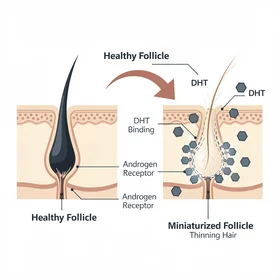
Your body produces testosterone. An enzyme called 5-alpha-reductase (5-AR) converts a portion of that testosterone into dihydrotestosterone (DHT). DHT is 3–5x more potent than testosterone at binding to androgen receptors.
In most of your body, DHT plays useful roles — it's involved in prostate function, body hair growth, and other androgen-dependent processes. The problem is specific to scalp follicles that carry a genetic sensitivity to DHT.
When DHT binds to androgen receptors in susceptible follicles, it triggers a cascade:
- Follicle shrinkage — the follicle physically gets smaller with each growth cycle
- Shorter growth phase — the anagen (growth) phase shortens, producing shorter hairs
- Thinner hairs — each successive hair is finer, lighter, and less visible
- Dormancy — eventually the follicle produces only microscopic vellus hair, then stops entirely
This process is called follicle miniaturization, and it's progressive. Once a follicle goes dormant, no current treatment can reactivate it.
Hair Loss Prevalence by Age
Why Location Matters
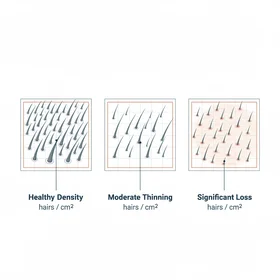
DHT doesn't attack all follicles equally. The follicles along the frontal hairline, temples, and crown have the highest density of androgen receptors — which is why male pattern baldness follows a predictable pattern (the Norwood scale). The follicles on the sides and back of the head are largely DHT-resistant, which is why they persist even in advanced baldness — and why they're used as donor hair in transplant surgery.
The Genetics Factor
Two men with identical DHT levels can have completely different hair loss outcomes. The variable is how their follicle androgen receptors are genetically programmed to respond to DHT. This sensitivity is polygenic — influenced by multiple genes inherited from both parents. The androgen receptor gene on the X chromosome (inherited from the mother) is significant, but paternal genetics matter too.
This is why DHT-lowering treatments work differently for different people. A man whose follicles are highly DHT-sensitive may need stronger intervention than one whose sensitivity is moderate.
Why Timing Is Everything
Here's the critical point: DHT-blocking treatments can only preserve follicles that are still functioning. Once a follicle has fully miniaturized and gone dormant, it's gone — no topical, pill, or supplement brings it back.
This means a man who starts DHT intervention at Norwood II (mild temple recession) has dramatically more to work with than one who waits until Norwood V (extensive loss). The treatment is the same; the outcome depends entirely on how many viable follicles remain.
Every month you wait is follicles you can't get back. This isn't a sales pitch — it's the biology. For a comparison of natural and pharmaceutical options, see our natural vs Rx breakdown.
If you're specifically dealing with a receding hairline, hairline-specific treatment strategies covers hairline-specific treatment strategies and what works at the temples versus the crown.